.png)
2025-26 has been a defining year for the Indian education sector.
Internationalisation, adoption of artificial intelligence, and announcement of reformatory measures to reduce complexity in institutional operations have been some of the key focus
areas. In terms of size, the sector is currently valued at over US $200 bn with projections to achieve over 50% growth over the course of the next 5 years. EdTech, after witnessing a series of headwinds, is once again becoming the key growth driver.
Roll out of the red carpet by Indian leadership, compounded with budgetary, visa, and immigration related issues in host countries have led to a series of announcements by
eminent foreign universities to establish campuses in the country, including University of Southampton, University of Liverpool, Illinois Institute of Technology, amongst others.
Similarly, in the K-12 segment, flexibility provided in setting up international board-affiliated schools by certain states has led to the entry of premium international school chains such as
King’s College, Shrewsbury International School & Harrow International School. We expect all major international school chains to have a deep presence in the Indian market over the
course of the next 3 years.
Taken together, these recent developments showcase the unprecedented rise of India as a destination for global education & research, driven largely by:
Expansion of premium international school chains
Entry of top foreign universities across the country with a high focus on research & innovation
New regulatory pathways enabling international participation, such as GIFT City’s IFSCA framework for International Branch Campuses and Offshore Education Centres
Emergence of planned education cities and knowledge clusters that co-locate academic institutions, research and industry
Realignment of domestic regulations
The introduction of the Viksit Bharat Shiksha Adhishthan (VBSA) Bill, 2025, in Parliament marks an important moment in the evolution of higher education governance. If enacted, the Bill has the potential to reshape the regulatory architecture by consolidating oversight and bringing greater consistency to how higher educational institutions are governed, assessed and held accountable. Additionally, ongoing reforms around NTA processes, accreditation and evaluation frameworks are altering how institutions prepare for quality assurance and regulatory scrutiny.
To gear up for the digital-first world, the Government has also initiated steps to integrate technology in the school curriculum, Skilling for AI Readiness (SOAR), which targets school students from classes 6–12. Furthermore, last year’s budget allocated INR 500 crore to establish a Centre of Excellence for AI in education.
Renewed investor traction
Internationalisation of the education sector, combined with massive latent demand, has led to heightened interest in the sector once again, both formal & non-formal. Investor appetite has now matured, with capital market and private equity activity reflecting this. In case of startups, the discussion around valuations seems to be more realistic & practical.
The successful public listing of a large coaching-focused EdTech company recently demonstrated that companies from this sector are ready to navigate the transition from private to public ownership, setting a pathway for new-age EdTech companies going down that route. At the same time, doubling down on investments by global funds, such as KKR’s additional investment in Lighthouse Learning, vindicates confidence in the sector. Blackrock, ChrysCapital, Warburg Pincus and Permira are other big names which have also shown keen interest.
Capital is now flowing into education in ways that would have seemed unlikely a decade ago. Private equity participation spans schools, early childhood education, test preparation, higher education and tech platforms.
This is the context in which Fox & Mandal present this informative whitepaper. The Indian education ecosystem today is complex, interconnected and dynamic. Navigating this sector is no easy feat, which is why this comprehensive guide is intended to help readers understand these intricacies.
This white paper brings together key market developments, regulatory and policy shifts alongside grounded perspectives on structuring, governance and transaction risks. Rather than offering abstract theory, this white paper aims to serve as a practical guide to the common realities of India’s education ecosystem.
I hope readers find this paper useful as they continue to engage with the opportunities that are shaping the next phase of this critical sector.
With one of the largest education systems in the world, India has made significant strides in expanding access, improving literacy outcomes, and integrating technology into learning ecosystems. The sector is undergoing a fundamental transformation, shaped by regulatory reform, evolving investment structures, and an increasing convergence between formal education and technology-enabled delivery models.
The education sector is subject to a complex regulatory ecosystem that encompasses Central and State legislation, fee regulation statutes, affiliation requirements, land and infrastructure norms, among others. Alongside these, active judicial intervention through a host of Supreme Court and High Court decisions has played a pivotal role in defining the contours of operational autonomy, fee fixation, surplus generation, and permissible regulatory intervention. For investors and operators alike, understanding this judicial and regulatory architecture is critical to evaluating risk, structuring transactions, and ensuring long-term sustainability.
Looking ahead, while the country’s education market presents significant headroom for growth, particularly in international schooling, higher education collaborations, EdTech, and tier-2 and tier-3 cities, the sector’s future will likely be shaped not only by capital inflows, but by the ability of policymakers, regulators, institutions, and investors to balance access, quality, affordability, and innovation within the existing legal framework.
This white paper is intended to serve as a reference point for stakeholders seeking to engage with the country’s education ecosystem, offering a structured view of the opportunities, constraints, and strategic considerations that define investment in one of the country’s most socially and economically consequential sectors.
Primary growth drivers
India’s education sector has expanded rapidly over the past decade, reflecting both demographic momentum and sustained policy focus. In 2025, the sector was valued at approximately USD 225 billion, nearly doubling from USD 117 billion in 2020, and is projected to maintain a robust growth trend, reaching a market size of USD 313 billion by FY2029-30, as per a CBRE report. This expansion is anchored in an education system of unparalleled scale, comprising nearly 1.5 million schools, over 10.1 million teachers, and nearly 248 million students enrolled across the foundational, primary, and secondary levels.
The sector is poised for healthy growth, as indicated by the latest CAGR estimates:
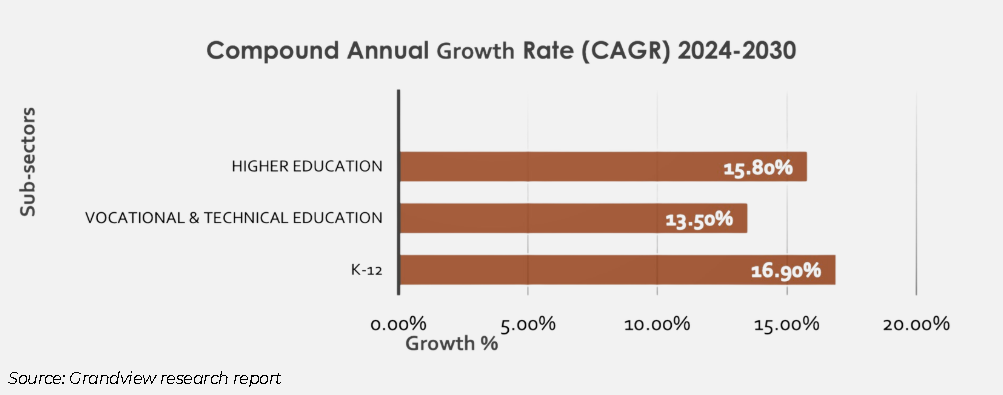
The scale is mirrored in higher education, with around 1,300 universities in 2025 (from 760 in 2014-15) and more than 52,000 colleges currently operational across the country. The QS World University Rankings, one of the world's most widely recognised and influential university ranking systems, provide a useful benchmark for assessing the global standing of higher education institutions. In the 2026 edition, 54 Indian universities featured in the rankings, up from 46 in 2025 and just 13 in 2015, underscoring not only the depth and diversity of India's education ecosystem but also the magnitude of opportunity it presents for innovation, capital deployment and institutional modernisation. Importantly, the system's size ensures that even incremental improvements in quality, efficiency, or access can translate into significant economic and social impact.
Even as each segment within the larger education ecosystem is being shaped by distinct demand drivers, regulatory dynamics, and technology adoption curves, the sector’s overall growth trajectory is underscored by several structural indicators:
Literacy rates continue to rise, with urban literacy at 92.9% for males and 84.9% for females, and rural rates at 84.7% and 70.4%, respectively, as per the Periodic Labour Force Survey (PLFS) 2023-24. This trend signals expanding participation and long-term demand.
The edtech sector became the third-most-funded sector in India in 2021, signalling strong investor confidence in technology-led education delivery. By 2025, the sector was valued at USD 7.5 billion and is projected to reach USD 29 billion by 2030. Its contribution to India’s GDP, which stood at a marginal 0.1% in 2020, is expected to rise to 0.45% by 2029, underscoring its growing macroeconomic relevance. As scale creates demand, technology has emerged as the principal enabler of reach, personalisation, and cost efficiency.
The country’s international school segment has witnessed steady expansion, reflecting both parental aspirations and growing institutional interest. The number of schools offering global curricula such as IB and Cambridge has growth rate of 10% in just five years. Within India, the market for international curriculum schools is projected to reach USD 14.67 billion by 2030, rising from USD 9.09 billion in 2021.
The UGC (Setting up and Operation of Campuses of Foreign Higher Educational Institutions in India) Regulations, 2023, have enabled top-ranked foreign universities to establish full-fledged branch campuses in India. Several institutions, including the University of Aberdeen, University of York, University of Western Australia, Illinois Institute of Technology, and Istituto Europeo di Design, have already received Letters of Intent to set up campuses across Bengaluru, Gurugram, and Navi Mumbai, with additional global universities actively evaluating the Indian market as a destination for long-term academic presence.
These campuses are expected to offer internationally benchmarked education at a fee approximately 25 to 30% lower than the cost of studying abroad, significantly improving accessibility for students while retaining global academic standards. This development represents a structural shift from student mobility to institutional mobility, positioning India as both a consumer and host of global higher education.
Increasing demand for affordable as well as premium education, coupled with rising quality consciousness among parents and learners, continues to drive growth across the education sector. The increasing integration of technology, expanding access, improved learning outcomes through personalisation, and the emergence of scalable and technology-driven delivery models are reshaping both digital-first platforms and traditional education segments. As institutions adapt to evolving consumer expectations, technological innovation and changing market dynamics, the sector presents significant opportunities for capital deployment, institutional modernisation and long-term value creation across the education ecosystem.
The governance of the education sector is shared between public and private stakeholders, all operating within a constitutionally anchored framework.
Education is a concurrent subject under the Constitution, enabling both the Union and the States to legislate on matters related to education. This constitutional arrangement has facilitated decentralised growth and regional responsiveness, but has also resulted in an extensive and, at times, overlapping statutory and regulatory landscape. Understanding this dynamic among policy objectives, regulatory control, and operational autonomy is essential for investors and operators to navigate the sector effectively.
Against this backdrop, some of the salient points of the regulatory framework governing the education ecosystem are summarised below:
A defining feature of India’s education system is its statutory treatment as a charitable and non-commercial activity. Rooted in Article 21-A of the Constitution of India and reinforced by the Directive Principles of State Policy, the no-profiteering principle mandates that schools, colleges, and universities be established and operated on a not-for-profit basis. Educational institutions are, therefore, typically structured as:
Societies under the Societies Registration Act, 1860
Trusts under the Indian Trusts Act, 1882
Section 8 companies under the Companies Act, 2013 (Companies Act)
While these institutions can generate reasonable surpluses, such surpluses must be reinvested exclusively towards educational objectives and institutional development.
Frameworks such as the Right to Education Act, 2009 (RTE Act), regulations issued by the University Grants Commission (UGC), and various State education statutes impose obligations relating to recognition, infrastructure standards, fee transparency, and financial reporting. Collectively, these regulations seek to balance public interest considerations with private participation, shaping both the risk profile and the structuring strategies for education-focused investments.
Pre-schools have traditionally operated with minimal regulatory oversight. The combination of relatively light regulation, low entry barriers, modest capital requirements, and franchise-based scalability has driven rapid private sector expansion, particularly in urban and semi-urban markets. Well-recognised brands such as Kidzee, EuroKids, Little Millennium, Shemrock, Kangaroo Kids, Hello Kids, Sanfort Preschool, KLAY, and Maple Bear have emerged as household names, reflecting strong parental demand for early childhood education.
Recent policy developments, however, signal a gradual move toward formal
regulation. In 2022, the National Commission for Protection of Child Rights issued
Regulatory Guidelines for Private Play Schools, establishing baseline norms
relating to recognition, infrastructure, safety standards, fee regulation, and audits.
Amongst others, certain States have taken the lead in formulating the Pre-school/
Play-school regulations in India.
| State | Regulation / Rule / Policy |
|---|---|
| Tamil Nadu | Code of Regulations for Play Schools, 2015 |
| Jharkhand | Jharkhand State Play Schools (Recognition and Control) Rules, 2017 |
| Andhra Pradesh | Andhra Pradesh Educational Institutions (Establishment, Recognition, Administration and Control of Schools Under Private Managements) Rules, 1993 |
| Maharashtra | ECCE Policy, Government of Maharashtra |
Together, these measures indicate an evolving regulatory sector that seeks to formalise the segment without materially constraining private participation.
The K-12 segment is the most structured and closely scrutinised component of the education system. Schools are broadly classified into government schools, private aided schools, and private unaided schools. Private schools must obtain recognition from the relevant State authorities, contingent on compliance with minimum standards prescribed under the RTE Act, including infrastructure norms, stude
nt-teacher ratios, and instructional hours. States may impose additional requirements, such as demonstrating financial sustainability, land ownership or leasing thresholds, and the necessity for a new school in a particular locality. Following recognition, schools may seek affiliation with State Boards, Central Boards such as CBSE and CISCE, or international Boards including IB and Cambridge, each of which involves separate approval processes and ongoing compliance obligations.An overview of school education Boards and affiliation frameworks:
| Board | Key functions | Affiliation |
|---|---|---|
| Central Board of Secondary Education (CBSE) | An all India board under Department of Education, prescribing and conducting Class X & XII exams; prescribes curriculum and syllabus. | Affiliation governed by CBSE bye-laws; only not-for-profit entities can establish CBSE schools. |
| Council for the Indian School Certificate Examinations (CISCE) | Conducts Indian Certificate of Secondary Education (ICSE) (Class X) and Indian School Certificate (ISC) (Class XII); requires schools to offer both ICSE & ISC. | Affiliation under CISCE guidelines; only not-for-profit institutions eligible. |
| International Baccalaureate (IB) | Offers Primary Years Programme, Middle Years Programme and Diploma Programmes; focuses on inquiry-based learning. | Schools must apply for IB World School status to be as per affiliation; subject to local State laws. |
| Cambridge International Education (CIE) | Offers five stages of education from age 3 to 19. | Schools affiliate with Cambridge International subject to State regulations. |
| State Boards | Formulated according to State-specific laws; prescribe syllabus, conduct exams at Class X & XII. | All State-run and aided schools, plus many private institutions funded by the States. |
This segment, one of the largest globally, encompasses universities, affiliated colleges, and stand-alone institutions offering a broad spectrum of general, professional, and technical programmes. With increasing alignment between academic offerings and labour market requirements, the sector is projected to reach a valuation of USD 313 billion by 2030, reinforcing its strategic importance for long-term investment.
Regulatory oversight is primarily exercised by the UGC, with support from specialised statutory regulators such as the AICTE, the National Medical Commission, and the Bar Council of India, depending on the discipline. Policy reforms under the National Education Policy 2020 (NEP), coupled with initiatives promoting multidisciplinary education, digitisation, skilling, and liberalised foreign investment norms, are reshaping the higher education landscape.
GIFT City has emerged as a specialised hub for international higher education under the IFSCA (Setting up and Operation of International Branch Campuses and Offshore Education Centres) Regulations, 2022 (IFSCA Regulations 2022), which permit eligible foreign universities to establish international branch campuses or offshore education centres within the GIFT City, subject to defined global ranking and reputation thresholds.
The eligibility is limited to universities in the QS Top 500 globally (overall or subject-wise rankings) or reputed Foreign Educational Institutions (FEIs) in their home jurisdictions. These campuses can offer full-time programmes (degrees, diplomas, research) in areas including Financial Management, FinTech, STEM disciplines, free from many domestic regulations (except those by IFSCA) that typically apply elsewhere in India.
Key drivers underpinning investment interest in GIFT City include
A leading UK- based University
Establishing foreign universities in India – Realities and opportunities
As interest in India’s education economy grows, conversations are swiftly shifting from ‘why India?’ to ‘how to succeed in India?’ For Foreign Higher Education Institutions (FHEIs), the window of opportunity is no longer theoretical but immediate, visible, and competitive. However, success in India will depend more on execution and far less on intent.
A significant feature of entering the Indian Higher Education market is that it is not a stand-alone decision but a series of interdependent choices. FHEIs must not only decide whether to establish a presence but also what form that presence should take – a full branch campus, an innovation- and research-led hub, a joint delivery model, or a specialised institute. Each route has distinct implications for academic control, regulatory positioning, capital investment, and brand positioning.
Looking ahead, India is likely to see the emergence of diverse institutional models, rather than a single dominant approach. While some universities will (& have already) establish full branch campuses, others are focusing on niche or specialised domains, and many are likely to adopt hybrid models that combine physical presence with international mobility pathways and some form of digital delivery. Early movers are already playing an important role in shaping the regulatory interpretation, partnership frameworks, and market expectations.
Finally, India should not be seen as an extension of an institution’s international strategy, but rather a strategic anchor market with its own right – the complexity, scale and dynamism of the ecosystem necessitate a differentiated, locally embedded approach. For FHEI’s planning to invest time, adjust their modes of delivery, and engage meaningfully with the ecosystem, India offers not just growth but an opportunity to shape (and be part of) a truly transformational global higher education system.
Over the past decade, India has witnessed a marked shift in parental preference toward international curricula. International schools, once concentrated in metropolitan centres, have expanded rapidly into Tier II and Tier III cities, reflecting rising household incomes and aspirations for globally aligned education pathways.
State-wise distribution of international schools
According to official directories of the respective Boards, India currently has approximately 812 CIE schools and about 256 IB World Schools. The concentration of such institutions is highest in economically advanced and urbanised States such as Maharashtra, Karnataka, Tamil Nadu, Telangana, Delhi, and Gujarat, reflecting stronger demand for globally recognised curricula in metropolitan regions.
Significant capital inflows have accompanied the rapid expansion of edtech and premium education models. From an investor standpoint, international schools offer attractive economics through premium fee structures, scalable franchise and managed models, and strong demand across urban geographies. To this end, there has been a spate of large-scale mergers, acquisitions, and funding rounds that underscore aggressive growth strategies aimed at scale, market capture, and vertical integration. Some of the leading and recent ed-tech transactions, and capital events from the recent past include the following:
| Transaction | Value* | Observations |
|---|---|---|
| BYJU's acquisition of Aakash Educational Services | USD 1 billion | Largest Indian edtech acquisition |
| BYJU's acquisition of Epic | USD 500 million | Entry into digital reading and early learning by acquisition of US-based Epic (a children's digital reading platform) |
| Eruditus Series F funding | USD 150 million | Reflects strong investor confidence in AI-driven learning, enterprise education, and the long-term growth potential of the edtech sector |
| LEAD School Series E funding | USD 100 million | First K-12 edtech unicorn in India |
| PhysicsWallah IPO clearance | USD 485 million | Marks transition from private capital to public markets |
| KKR acquisition of EuroKids | USD 200 million | Strong investor conviction in the consolidation and scalability of organised preschool |
| Nord Anglia acquisition of Oakridge International | USD 200 million | Highlights increasing global investor interest in India's premium K-12 education sector |
| Ryan EduNation joint venture | USD 100 million | Franchise and managed school expansion |
| Adani Foundation collaboration with GEMS Education | USD 240 million | Establishment of world-class schools across India |
| Kido International and Amelio Early Education | - | UK-based chain acquiring Chennai/Bengaluru preschool operator |
| Ryan Group of Institutions and Royal Grammar School Guildford | - | The new state-of-the-art co-educational school, to be known as RGSG Bengaluru, featuring impressive facilities spread across 14 acres |
* Values are approximate, based on a USD to 80.95 INR conversion rate.
Of late, the market seems to have entered a more disciplined phase. Unlike the earlier cycle of valuation-led expansion, the next wave of capital deployment is expected to prioritise sustainable unit economics, governance robustness, regulatory compliance, and long-term profitability, with hybrid education models that integrate physical infrastructure with digital delivery increasingly viewed as the most resilient investment propositions.
Opportunities and challenges for international schools in India
UK independent schools have, for several decades, sought to enhance their global footprint and obtain additional income streams through opening partner schools in non-UK jurisdictions. These have generally involved a licensing model whereby a new school is established and operated by a local partner in accordance with standards set by the UK school. The licensing model provides a low-risk avenue for entry while enabling the UK school to preserve and enhance its reputation.
The favoured hotspots have changed from year-to- year but recently many schools have looked favourably at setting up schools in India. India's education sector offers a dynamic opportunity for UK schools to extend their global footprint, with a burgeoning demand for premium education. However, navigating the regulatory, cultural and commercial nuances is essential for success.
Market insights and the growth of premium education
India is home to one of the youngest and fastest- growing populations globally, with more than 500 million people under 25. This demographic is driving rapid growth in demand for high-quality education. UK education brands, known for their holistic approach to education and rigorous academic standards, resonate strongly with Indian parents seeking global credentials for their children.
The market for premium international education is expanding, and not just in the major metropolitan areas. The regions are increasingly seeing a rise in demand for branded international schools, where UK institutions have a significant opportunity to establish their presence through licensing arrangements.
Key legal considerations
It is vital at the outset of a project for a UK school to file appropriate Indian trade mark applications. Without an Indian trade mark application, a UK school is unlikely to have any practical means of stopping misuse of its name and crest by a third party.
Partly due to India's restrictions on foreign ownership of educational institutions, a UK school will invariably partner with an Indian organisation that will operate the school in accordance with an agreement between the parties. That agreement will typically be governed by English law, but it is nevertheless vital to understand and comply with India's local regulatory context and tax regime.
A key aim for the agreement is to set a framework in which the ethos of the UK school can be accurately replicated in an Indian context. This means balancing the preservation of what is core to that ethos with the humility to adapt, and to recognise that even the best can be improved. India of course has its own excellent schools, from which premium UK schools can learn (for example, in community engagement, resource management and cultural sensitivity).
Building b partnerships: time, visits and relationship-building
While the agreement is of course very important, the key to a really successful project is to find a partner with shared values and ambition.
Allowing ample time for discussions is crucial when establishing a licensing agreement. These agreements often require careful attention to detail and must be structured to avoid future misunderstandings. It is also vital for UK institutions to engage in regular dialogue with potential Indian partners, both through site visits and by inviting partners to visit the UK. These visits foster a deeper understanding of each other's operational culture and educational expectations, ensuring that the project is built on trust and shared values.
Just remember though that these are very long term projects. A school established in India today will hopefully remain successful into the next century and beyond. So great personal relationships today must be backed-up by thoughtfully negotiated agreements that will continue to work for future generations.
Outlook
More immediately, the next five years should offer significant growth opportunities for UK schools in India. The demand for international education will continue to rise, driven by economic expansion and the growing desire for globally competitive skills and access to elite Universities.
UK schools must remain agile as the education environment in India evolves. Stricter guidelines around foreign partnerships and quality control may emerge, and the increasing sophistication of local educational providers means that UK schools will need to work with reliable, capable local partners to mitigate operational risks.
Motivated by overarching goals of balancing access, equity, quality, and private participation, the country’s legal, regulatory, and policy environment has played a key role in directing and defining the permissible contours of capital flows and investment structures. Understanding these policy drivers is, therefore, essential to assessing both the inherent opportunity as well as risk in this sector.
Key policies and enabling schemes
Foreign participation in education is further shaped by India’s foreign exchange and foreign contribution regimes. Institutions receiving funds from foreign sources must navigate the FEMA and the FCRA, which define how foreign funds, including contributions and permissible fee receipts, can be received, utilised, and reported. The FCRA’s expansive definition of ‘foreign contribution’, encompassing donations, transfers, and certain fee receipts, has historically created ambiguity in compliance for NFP entity structures.
Notably, these regulatory sensitivities are compounded by the no-profiteering principle embedded in both Central and State education laws. Private schools are required to be sponsored exclusively by NFP entities, typically societies or public trusts. This requirement, reinforced under the RTE Act and state recognition frameworks, restricts direct equity participation and necessitates alternative investment structures, thereby increasing transaction complexity for international investors.
The RTE Act operationalises the constitutional mandate for free and compulsory education for children aged six to fourteen. Beyond its access focus, the Act imposes specific regulatory obligations on private institutions, such as mandatory reservation of 25% of seats for students from disadvantaged and weaker sections of society, adhering to transparent norms for infrastructure and teacher–student ratios, and refraining from capitation fee and discriminatory admissions procedures.
The higher education regulatory framework has shown greater responsiveness to globalisation and collaboration. The UGC has introduced regulations enabling foreign universities within the global top 500 rankings to establish branch campuses in India, as well as frameworks permitting twinning, joint degree, and dual degree programmes between Indian and foreign institutions. Some of these forward-looking regulations that expand institutional engagement models are:
The UGC (Setting up and Operation of Campuses of Foreign Higher EducationalInstitutions in India) Regulations, 2023 allow top-ranked foreign universities (global top 500) to establish branch campuses domestically.
From an investment perspective, these regulations open new engagement pathways that combine academic collaboration with premium programme delivery. However, participation demands significant institutional preparedness, including infrastructural capability, compliance maturity, and brand credibility, limiting immediate eligibility to well-capitalised and established institutions.
Fee regulation represents one of the most sensitive areas of policy intervention. While a majority of states in India remain unregulated in this aspect, several states (Delhi, Maharashtra, Gujarat, Rajasthan, Assam, Chhattisgarh, Andhra Pradesh, Jharkhand, Punjab, Haryana, and Mizoram, etc.), have enacted statutes aimed at ensuring transparency and preventing arbitrary fee increase.
The below table provides insight into some of these laws, which introduce disclosure obligations, committee-based approvals, and grievance redressal mechanisms, with varying degrees of regulatory intensity:
| Statute | Key provisions |
|---|---|
| The Delhi School Education (Transparency in Fixation and Regulation of Fees) Act, 2025 |
|
| Maharashtra Educational Institutions (Regulation of Fee) Act, 2011 |
|
| Gujarat Self-Financed Schools (Regulation of Fees) Act, 2017 |
|
| Rajasthan Schools (Regulation of Fee) Act, 2016 |
|
Indirect tax treatment
Income tax incentives
Educational entities established solely for educational purposes and not for profit are eligible for income tax exemptions under Section 10(23C) of the Income-tax Act, 1961.
GST treatment across education services
| Service type | Description | GST rate | Exemption |
|---|---|---|---|
| School education | Pre-school, primary, secondary | Nil | Yes |
| Higher education | Colleges and universities | Nil | Yes |
| Professional coaching | Skill and exam preparation | 18% | No |
| E-learning | Private tutoring and exam preparation | 18% | No |
| Vocational training | Online and digital courses | 18% | Only to recognised courses |
Policy openness has been reinforced by a progressively liberalised Foreign Direct Investment (FDI) regime. The education sector now permits up to 100 % foreign investment under the automatic route, enabling international investors to deploy capital without prior Government approvals. This liberalisation has been particularly consequential in edtech, higher education, and vocational training, aligning regulatory intent with market demand. Industry reports indicate that the sector has attracted close to USD 10 billion in equity investments through strategic acquisitions, private equity and venture capital funding, reflecting sustained investor interest in India's education ecosystem.
At the centre of recent reform efforts lies the NEP, which represents the most comprehensive reimagining of education governance in decades. The policy articulates a long-term vision that spans foundational literacy and numeracy, early integration of vocational education from Grade 6 onwards, and a shift toward multidisciplinary and flexible higher education institutions. Equally significant is its emphasis on technology- enabled learning through national digital platforms, adaptive tools, and blended delivery models. Collectively, these measures aim to modernise pedagogy, improve learning outcomes, and create systemic readiness for scale.
Some of the key features of NEP are as follows:
Alongside these established regulatory regimes, a significant recent development in the policy landscape is the introduction of the Viksit Bharat Shiksha Adhishthan Bill, 2025, which proposes to overhaul the higher education regulatory architecture by replacing multiple existing bodies with a unified statutory commission. The Bill seeks to subsume the regulatory functions of the UGC, AICTE, and National Council for Teacher Education under a single apex body with three independent councils for regulatory oversight, accreditation, and standards setting. Introduced in the Lok Sabha in December 2025 and referred to a Joint Parliamentary Committee for scrutiny, the legislation aims to streamline regulatory complexity, align with the institutional goals under NEP 2020, and enhance institutional quality and competitiveness. However, as the Bill remains under parliamentary review, its eventual shape and implications for autonomy, compliance burden, and institutional governance will depend on deliberations and amendments during the legislative process.
Beyond investment liberalisation, the Government has actively built enabling frameworks to catalyse digital transformation. Initiatives such as the National Digital Education Architecture and the National Education Alliance for Technology are designed to create interoperable platforms and partnerships between public institutions and private innovators. Complementary schemes such as the Startup India Seed Fund Scheme further support early-stage education technology ventures, encouraging experimentation and innovation at the ecosystem level rather than through isolated interventions.
While these frameworks enhance accountability and mitigate profiteering, they also introduce procedural overheads and revenue uncertainty, potentially dampening investor sentiment, especially for models dependent on predictable fee escalations.


 Capital Markets & Securities Law
 Corporate & Commercial
 Employment & Labour
 Government & Regulatory
 Real Estate